Life
Protect living beings and respond to avoidable harm with care.
What if we could seek what is real, care for one another, and build peace—without asking everyone to become the same?
Open to inquiry. Grounded in dignity. Always voluntary.

From You to I, to We as One.
From one, sees all. The rest is yet to come.
A beginning we can share
The Assembly exists for people who take questions seriously, treat one another with dignity, and believe understanding should lead to care.
We make space for spirituality and scholarship, testimony and evidence, reflection and practical action. Differences remain visible. No person owns truth—and no person has to surrender conscience to pursue it.
There is no spiritual rank here. The founder and every participant stand on equal human ground.
THE VERITAS ROOT
Founded through Zackery Carmon Miller’s Veritas work, the Assembly brings the pursuit of truth into study, conscience, community, and care. Its common ground is freedom and world peace.
The founding spiritual premise is one Creator and a connected history of human existence. We study the fragments of the human past in their own context, preserving sources, differences, and uncertainty. A proposed connection remains open to examination.
People retain their own faith, non-faith, and conscience. There is no worship of the founder, no superior spiritual rank, and no compulsory belief. Each person chooses a path of inquiry.
Read the founder’s personal account ↗FOUR RIGHTS · EVERY CREATURE
We stand for four unalienable rights of every creature. This is the Assembly’s ethical commitment to living beings and freedom of conscience.
Protect living beings and respond to avoidable harm with care.
No one owns another person’s choices or conscience.
Leave people free to seek a meaningful life.
Question, examine evidence, learn, and correct mistakes.
These are Assembly-declared values. They do not replace the full range of human or legal rights, or assert that every jurisdiction recognizes the same rights for every creature.
Read the proposed Evangelist’s Oath ↗Remember our purpose. Protect choice. Care for life. Keep the evidence open to correction.
Hold purpose, source, context, and responsibility together. A compelling story does not replace the people and evidence behind it.
I / IV
These governance commitments help carry the work. The four rights above express our ethical purpose. The proposed oath is available on the community page; formal membership remains closed.
AQTĀ · AHK-tah · the synthesis framework
AQTĀ brings questions, sources, experiences, and traditions into a disciplined conversation. It preserves what we know, names what we don't, and leaves room to change our minds.

These optional prompts can help begin an inquiry. Each person chooses their path; claims still need sources, examination, and room for correction.
Identify the original witness or author, people affected, and any voices missing from the record. An account is a source, not automatic proof of its interpretation.
Wisdom is not ours to claim. The Assembly studies traditions in their own context—from historical accounts of justice and truth to modern methods of inquiry.
We keep source, meaning, disagreement, and uncertainty attached to every fragment. A beautiful connection is a question worth examining, not proof that two traditions say the same thing.
Not three kinds of people. Three ways to carry responsibility into daily life.

Listen, examine evidence, and correct mistakes without shame.

Let what we understand become protection, service, and follow-through.

Honor conscience, reflection, and personal faith without imposing belief.
Equal standing, freedom of conscience, and room for honest doubt.
People may explore, ask, decline, contribute, pause, and leave. Confirmed members share one designation—Evangelist—but not a higher human or spiritual status.
Learn how participation worksRespect is not silence. Inquiry is not coercion. Together we can practice both.

Yes. Respectful disagreement, evidence, and correction are welcome. No teacher or founder is above examination.
No. People may retain their own faith, non-faith, and identity. The Assembly is not a house of worship.
No. Browsing, attending, or asking a question never enrolls you. Membership requires a separate affirmative choice and appropriate safeguards.
Observation, testimony, records, and interpretation can all be studied—but we distinguish them. A belief is not automatically a proven fact; new evidence can change a conclusion.
Yes. Participation is voluntary. You may decline contact, pause, or leave without spiritual penalty.
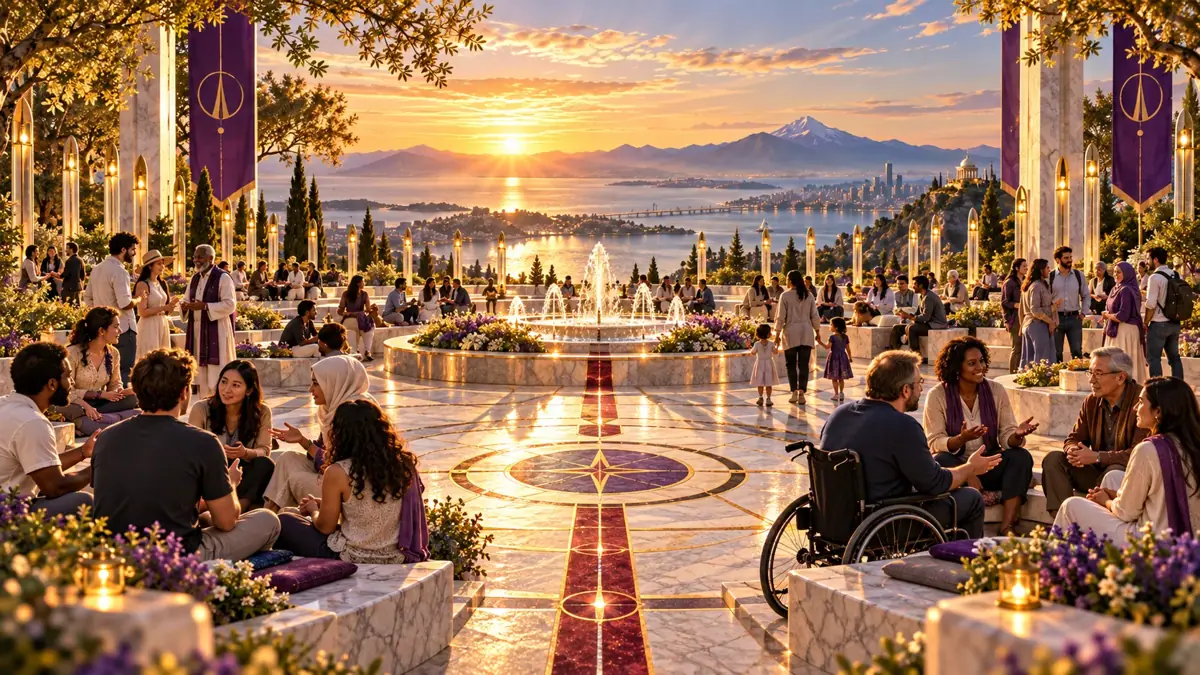
Ten conceptual scenes of welcome, research, care, and possibility. These are illustrations of the Assembly's aspirations—not photographs of existing facilities.
Explore freely. Think independently. Share what matters. There is room here for you—even if you never join.
Ask a questionEmail opens your own mail app. This website does not collect or submit personal information. Please don't include sensitive personal or child information in an initial inquiry.
10 / THE OPEN RECORD
Question the work. Protect the person.